Saturday, April 22, 2006
The Perfect Beauty
All I know is that there is a Flash program which is generating these images but I haven't got a clue how it's done.

Fibonacci sequence
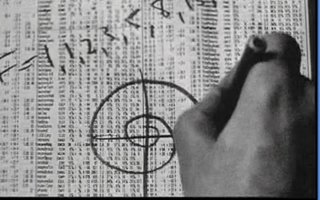
Max Cohen, the main character in the movie Pi, explains some properties of the Fibonacci sequence.
Tuesday, April 18, 2006
True or false?
"... The current world record for pi memorization was made in 1995, when a Japanese man recited 42,000 digits from memory in just over nine hours. ..."
Would this really be true? I suppose so, since I read it on PI, the movie.
Would this really be true? I suppose so, since I read it on PI, the movie.
The Phi Number System
I watched the movie pi this weekend. A movie about a Number Theorist who thinks he has found a very, very special number of exactly 216 digits. Both the CIA, and Jewish fundamentalists are after him, the latter think the number is the key to The Garden of Eden. This movie is not a typical Hollywood thriller as it is directed by Darren Aronofsky, who later directed Requiem of a Dream. Filmed in 1998, it's a black and white movie trying to create an atmosphere of the late fifties or early sixties. Not that it matters, mathematics is the same in all times. Now, one million years ago and forever and forever in the future. Mathematics is exactly that what does not change over time. PI will forever be ~3.14.
( The mathematician, Max Cohen, is played by the same actor who played 'Arnold, the Shrink' in Requiem for a Dream, a great actor. In fact, the assistant of the doctor in Requiem, the Indian girl, is Max'es neighbour girl in pi. The older professor who has been searching for patterns in the digits of pi for more than 40 years ( without any result ) is the owner of the pawnshop in Requiem. That's what they call Trivia. )
I love mathematics it fills my life with joy, energy, enthusiasm. Take today, for instance. As I am in the middle of projects, mathematics projects I mean, I feel a bit unsure about the direction I should pursue. Computational Group Theory? Representation Theory? And then this idea of building a 3D-model of the BrainTwist game, including a group theoretic analysis of it all, and if that isn't enough, a solution for the game. Rather ambituous, although I am sure I can do it. The construction of the 3D Rubik gave me that confidence. I am still swimming in uncertainty. But the emptyness is gone. Filled with beaty of... the Phi Number System. It was as though lightning struck. I have been warned that pi is the sort of movie that slowly gets you, sometimes days after it was seen. In my case I noticed a strong resemblence with the 3x+1 Research I have been doing early 2005, how time can fly.
Where is all this beauty?
( The mathematician, Max Cohen, is played by the same actor who played 'Arnold, the Shrink' in Requiem for a Dream, a great actor. In fact, the assistant of the doctor in Requiem, the Indian girl, is Max'es neighbour girl in pi. The older professor who has been searching for patterns in the digits of pi for more than 40 years ( without any result ) is the owner of the pawnshop in Requiem. That's what they call Trivia. )
I love mathematics it fills my life with joy, energy, enthusiasm. Take today, for instance. As I am in the middle of projects, mathematics projects I mean, I feel a bit unsure about the direction I should pursue. Computational Group Theory? Representation Theory? And then this idea of building a 3D-model of the BrainTwist game, including a group theoretic analysis of it all, and if that isn't enough, a solution for the game. Rather ambituous, although I am sure I can do it. The construction of the 3D Rubik gave me that confidence. I am still swimming in uncertainty. But the emptyness is gone. Filled with beaty of... the Phi Number System. It was as though lightning struck. I have been warned that pi is the sort of movie that slowly gets you, sometimes days after it was seen. In my case I noticed a strong resemblence with the 3x+1 Research I have been doing early 2005, how time can fly.
Where is all this beauty?
Friday, March 17, 2006
Serious work to be done...
... on math ( group theory ). Hard work is required. Work is play. Work hard, play hard.
( MORE LATER... )
( MORE LATER... )
Tuesday, January 24, 2006
Glimpses of Algebra and Geometry
I have read somewhere that at a deep level algebra, geometry and number theory are representations of the same mathematical entities. This book presents topics in math from the perspective of different mathematical disciplines. It is also a beautiful and fun to read book.

Wednesday, December 28, 2005
A 6****** star math book
I don't rate something 5***** stars easily. I mean what's beyond 5? Today I found a book for which a 5 star rating is simply too low. The book is extremely:
- different
- relevant
- interactive ( even more so than some math 'websites' )
- challenging
- fun.
If there is a book which I ever rated as a 5***** it must be Concrete Mathematics from Graham, Knuth and Patashnik. Polynomials, that's how it's called, is like that but much more coherent. It is a * * * * * * rating, to me anyway. Must have, must read, can't wait, buy now.
Oh, eh, it is out of print, sorry. Not for sale. ;-)
- different
- relevant
- interactive ( even more so than some math 'websites' )
- challenging
- fun.
If there is a book which I ever rated as a 5***** it must be Concrete Mathematics from Graham, Knuth and Patashnik. Polynomials, that's how it's called, is like that but much more coherent. It is a * * * * * * rating, to me anyway. Must have, must read, can't wait, buy now.
Oh, eh, it is out of print, sorry. Not for sale. ;-)
Friday, December 16, 2005
Group Explorer 2.0
"... Group Explorer is mathematical visualization software for the abstract algebra classroom. Users can explore dozens of finite groups (and morphisms among them) visually and interactively. ..." 
GE 2.0 developer Nathan Carter.
Where GAP is targeted to professional algebra researchers and Mathematica Abstract Algebra to students who already have completed one or two abstract algebra courses and know the ins- and outs of Mathematica, Group Explorer is meant for beginners. A beautiful tool to demonstrate properties of a limited number of small groups. Version 2.0 is primarily a "look and feel" release. The program is free and downloadable as C++ source or executable.
GE 2.0 developer Nathan Carter.
Where GAP is targeted to professional algebra researchers and Mathematica Abstract Algebra to students who already have completed one or two abstract algebra courses and know the ins- and outs of Mathematica, Group Explorer is meant for beginners. A beautiful tool to demonstrate properties of a limited number of small groups. Version 2.0 is primarily a "look and feel" release. The program is free and downloadable as C++ source or executable.
Thursday, December 15, 2005
Lie Algebras
e^ A, e to the power matrix A, e to the power {{2,0},{0,1}}.
Matrices as power coefficients.
Is that cool, or what?
Matrices as power coefficients.
Is that cool, or what?
Friday, November 25, 2005

Friday, November 11, 2005
TeXnicCenter
As far as mathematics is concerned I am more or less illiterate. I can read a bit but when it comes to writing I freeze entirely. What to write? I just can't formulate my thoughts in a mathematical correct manner. What is worse? Well, I can't even reproduce a text from some math book. Look at me, on my age, learning to type. It is depressing. Look at the bright side, I have TeXnicCenter. That's a start. You can't write a letter without a pen either.
Sunday, October 23, 2005
Groups of order 18
There are 5 groups of order 18:
gap> grp(18);
Group 1 has structure: D18 and is Non-Abelian
Group 2 has structure: C18 and is Abelian
Group 3 has structure: C3 x S3 and is Non-Abelian
Group 4 has structure: (C3 x C3) : C2 and is Non-Abelian
Group 5 has structure: C6 x C3 and is Abelian
The workhorse here is the function ConstructAllGroups and is part of the GAP package GrpConst.
gap> grp(18);
Group 1 has structure: D18 and is Non-Abelian
Group 2 has structure: C18 and is Abelian
Group 3 has structure: C3 x S3 and is Non-Abelian
Group 4 has structure: (C3 x C3) : C2 and is Non-Abelian
Group 5 has structure: C6 x C3 and is Abelian
The workhorse here is the function ConstructAllGroups and is part of the GAP package GrpConst.
#
# Prints all groups of order n
# IN: Group
#
grp:=function(n)
local listGroups;
listGroups:=ConstructAllGroups(n);
i:=1;
while(i<(Length(listGroups)+1)) do
 Print("Group ");
 Print(i);
 Print(" has structure: ");
 Print(StructureDescription(listGroups[i]));
 Print(" and is ");
 if (IsAbelian(listGroups[i])) then
  Print("Abelian");
 else
  Print("Non-Abelian");
 fi;
 Print("\n");
 i:=i+1;
od;
end;
Subscribe to:
Posts (Atom)
Popular Posts
-
Among lectures on Calculus I,II and III, ( Introduction to ) Linear Algebra and ( Introduction to ) Differential Equations from the UCCS ( ...
-
Problem: We want to calculate the sum of the elements of a list of numbers. Suppose this list is named l and has been assigned the value {1,...
-
 Today I started to read the Ramanujan biography ( The e-book version, of course. ) The book looks promising. What was it like to communicate...
 -
I found a set of video lectures on Abstract Algebra. MATH E-222 Abstract Algebra - http://www.extension.harvard.edu/openlearning/math222/ E...
-
 Ramanujan's genius (r) was discovered by Hardy (l) At a very young age Ramanujan designed the following formula for a 3 by 3 magic sq...
Welcome to The Bridge
Mathematics: is it the fabric of MEST?
This is my voyage
My continuous mission
To uncover hidden structures
To create new theorems and proofs
To boldly go where no man has gone before

(Raumpatrouille – Die phantastischen Abenteuer des Raumschiffes Orion, colloquially aka Raumpatrouille Orion was the first German science fiction television series. Its seven episodes were broadcast by ARD beginning September 17, 1966. The series has since acquired cult status in Germany. Broadcast six years before Star Trek first aired in West Germany (in 1972), it became a huge success.)


